Comparison
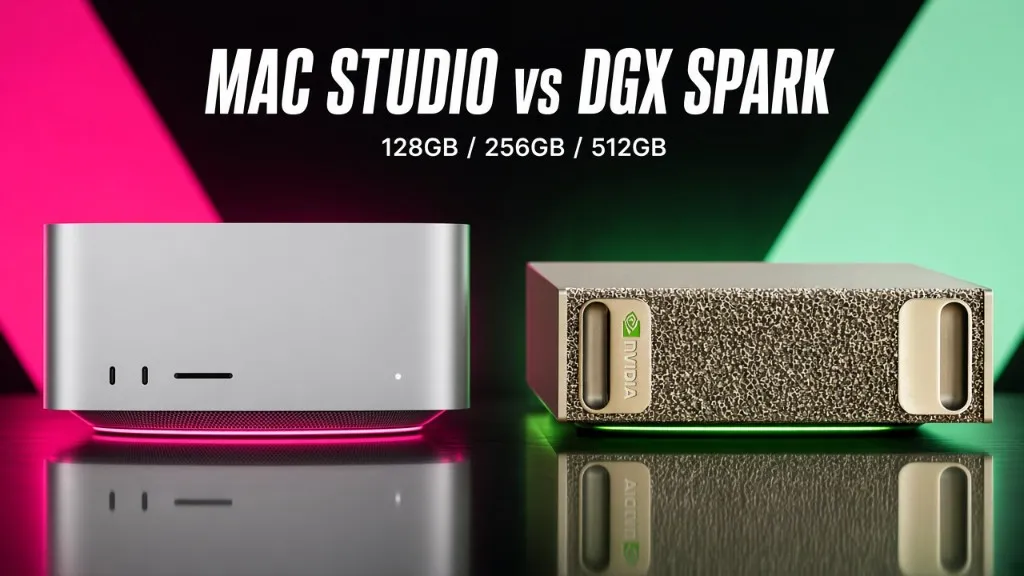
Can the 512GB Apple Mac Studio Dethrone the nVidia DGX Spark?
One 512GB Mac Studio lists at $22,299 and generates text faster than a single DGX Spark. Four Sparks list at $27,800 plus a switch to match the memory, and they catch the Mac when the prompt is long.
Key takeaways
The 512GB Mac Studio M5 Ultra is the faster single box. Tom's Hardware measured 46.3 tok/s against 11.8 tok/s for a DGX Spark on Qwen 3.8 27B. Four Sparks list at $27,800 plus a switch to reach about 512GB, and paired Sparks can match the Mac at reading long prompts.
In this article
Mac Studio vs. DGX Spark: Apple wins on decode speed and price per gigabyte, and Nvidia has the better network
Matching a Mac Studio’s memory with DGX Sparks costs more at every tier, and the Mac generates text faster. Nvidia’s 200-gigabit ConnectX-7 ports, CUDA, and strong prefill keep the Spark relevant, especially if you buy Dell’s version.
Nvidia’s DGX Spark arrived a year ago as a $3,999 desktop with 128GB of memory and a small Grace Blackwell chip. It doesn’t sell at that price anymore. The memory shortage pushed it to $4,699 in February, and it now lists at $6,950. Meanwhile, Apple has filled in its Mac Studio lineup at 128GB (M5 Max), 256GB, and 512GB (M5 Ultra), and enabled RDMA clustering over Thunderbolt 5.
Both companies now sell the same idea, a quiet desktop box that can be connected to others to hold a frontier-size open model. We priced them against each other at equal memory, including the cables and switches that clustering requires.
If you’d like to try this GPU before you buy, consider renting on vast.ai.
The price at each tier
Apple’s 128GB option is the M5 Max with 18 CPU cores and 40 GPU cores, at $5,399 with 1TB. For 256GB you need an M5 Ultra, which costs $9,499 with the 64-core GPU or $10,799 with the 80-core version. The 512GB Ultra costs $22,299. Two 256GB Ultras connected with a cable cost $21,598 for the same total capacity.
Every Spark has 128GB, so matching the Mac takes one, two, or four of them. Nvidia’s own box is the most expensive way to buy a GB10. Dell’s Pro Max with GB10 uses the same chip, the same 128GB, and the same ConnectX-7 networking, and costs $5,523 with 1TB ($5,903 with 2TB). ASUS’s Ascent GX10 is another option, but we couldn’t find a current US list price for it. Nvidia’s 64GB Spark tier from $4,999 doesn’t help with this kind of capacity matching.
| Tier | Mac Studio | DGX Spark (Nvidia) | Dell Pro Max GB10 |
|---|---|---|---|
| 128GB | M5 Max, $5,399 | 1 box, $6,950 | 1 box, $5,523 |
| 256GB | M5 Ultra 64c, $9,499 | 2 boxes + DAC, $13,984 | 2 boxes + DAC, $11,130 |
| 512GB | 2x Ultra 256GB + cable, $21,667 (single box $22,299) | 4 boxes + switch, $29,454 | 4 boxes + switch, $23,746 |
| Bandwidth per box | 614GB/s (Max), 1.2TB/s (Ultra) | 273GB/s | 273GB/s |
List prices, plus a $84 DAC for two GB10 boxes and a $1,295 MikroTik switch with $359 of breakout cables for four.
The Mac is cheaper at all three tiers. At 512GB the gap with Nvidia-branded Sparks is about $7,800. Dell’s GB10 narrows that to roughly $2,100, and a switchless ring (below) would cut it further.
Bandwidth sets decode speed, and the Mac has much more
All GB10 machines use LPDDR5x at 273GB/s. The M5 Max reaches 614GB/s and the M5 Ultra reaches 1.2TB/s. Because generating text means reading the model’s active weights once per token, that ratio carries over into decode speed fairly directly. In Tom’s Hardware’s testing on Qwen 3.8 27B, as summarized by Contra Collective, the M5 Ultra generated 46.3 tok/s and a single Spark 11.8.
Per-box memory bandwidth. Two Sparks running tensor parallelism can roughly double their effective figure.
The Spark’s advantage is compute. On prefill, the stage that reads the prompt, a pair of Sparks matches or beats one M5 Ultra. PixelML’s club-dgx-spark benchmarks recorded 2,960 tok/s on Qwen3.8-Flash-Next at 16K tokens, against MacStories’ 2,887 on the Mac, and 1,277–1,372 tok/s on GLM-5.3-Flash against the Mac’s 1,107. On decode, one X user’s matched-prompt test put a 256GB M5 Ultra ahead of two GB10s on all three models tried, by between 9 percent and 2.6x. The two setups used different runtimes and quantizations, so treat those numbers as indicative.
Field results, not a controlled benchmark. Runtimes: oMLX on the Mac, vLLM with tensor parallelism on the Sparks.
Concurrency is the other strength of the Spark. PixelML’s two-node setup served 275 tok/s in aggregate across 16 simultaneous requests. MacStories saw a single Mac go from 66 tok/s with one request to 81.5 with three. If several people or agents will share the hardware, that matters more than single-stream speed.
If you’d like to try this GPU before you buy, consider renting on vast.ai.
The interconnect: 200GbE against Thunderbolt 5
On networking, Nvidia has the stronger hardware. Every GB10 has a ConnectX-7 NIC with two QSFP ports at up to 200Gb/s each, and RoCE RDMA works with NCCL out of the box. The Mac Studio’s Thunderbolt 5 ports are rated at 80Gb/s both ways, or up to 120Gb/s in one direction, and have supported RDMA since macOS 26.2. Both machines also have a 10GbE RJ45 port, which is fine for management and too slow for tensor parallelism.
Rated line rate per link.
Topology matters as much as speed. With two QSFP ports, three Sparks can form a fully connected ring with no switch. Nvidia publishes a playbook for this. Nvidia’s Sync tool supports four nodes through a 200GbE switch. According to Petronella Tech, Nvidia announced support for eight-node clusters on October 22nd and published results for switchless four- and eight-node rings that rely on NCCL’s ring algorithm. We found only that one secondhand report, and Resilient Tec’s guide, dated October 26th, still calls the four-node ring unsupported. Treat it as unconfirmed.
Macs have the opposite constraint. Thunderbolt 5 switches don’t exist, and MLX’s RDMA backend and exo both require a full mesh, with a direct cable between every pair. With six Thunderbolt 5 ports on the M5 Ultra (four on the M5 Max), and exo noting that the port next to Ethernet can’t do RDMA, the M5 Max reaches its limit at four machines. The Ultra has spare ports for five, though we found no public five-node test.
Port-count limits. The eight-node Spark ring figure comes from a single secondhand report of Nvidia’s October 22nd announcement.
What the networking costs
Smaller clusters on both platforms cost very little to connect. Two Macs need one $69 Apple Thunderbolt 5 Pro cable, and two Sparks need one QSFP DAC. Resilient Tec sells the MCP1650-V00AE30 for $84, and the Nvidia-validated Amphenol NJAAKK-N911 for $154. Three nodes cost $207 in Thunderbolt cables versus $252–$462 for a three-DAC Spark ring.
The difference shows up at four. Four Macs need six cables, $414. Four Sparks on Nvidia’s supported topology need a 200GbE-class switch. MikroTik’s CRS804-4DDQ lists at $1,295, and two 400G-to-2x200G breakout DACs add $358.90, for $1,654. A cheap 10Gb SFP+ switch like MikroTik’s $269 CRS309 would work with the Spark’s RJ45 port only through adapters, and would drop each link from 200Gb/s to 10Gb/s, which wastes the Spark’s main networking advantage. The MikroTik CRS504, a $799 100GbE switch, is a middle option at half the link speed (est. compatibility; we found no published Spark build on it).
Cables and switches at list price.
Why the speed matters
For tensor parallelism, where every layer is split across boxes and synchronized after each one, link speed and latency limit scaling. On that measure the Spark’s 200GbE fabric is better hardware than Thunderbolt. Nvidia’s own tests cut Llama 3.3 70B time-per-token from 269ms on one node to 72ms on four, a 3.7x improvement. Apple’s four-Mac tensor-parallel run improved Qwen 3.8 27B by 2.6x, from 19.7 to 50.9 tok/s. Those are different models and not directly comparable, but the pattern matches the link speeds. The Mac starts from a much faster single box, so even with weaker scaling, four Macs generate more tokens per second.
Pipeline parallelism needs much less bandwidth, and either platform handles it easily. That’s also how exo’s widely shared Spark-plus-Mac demo divided the work, with prefill on the Sparks and decode on the Mac. In one independent attempt to reproduce it, the Spark contributed only memory.
What fits, and what runs it
At 128GB, both platforms run Qwen3.8-Flash-Next at 4-bit or squeezed versions of GLM-5.3-Flash. At 256GB, one M5 Ultra or two Sparks hold GLM-5.3-Flash at 4-bit. At 512GB, DeepSeek V4.1-Flash (552B MoE, about 294GB at 4-bit in MLX) fits either a single 512GB Mac or four Sparks. Full GLM-5.3 at 4-bit (about 419GB) has been run across four Sparks at 2.75 bits per weight.
The software ecosystems differ more than the hardware does. GB10 runs CUDA, vLLM, SGLang, and TensorRT-LLM, the same tools used in data centers, so code written on a Spark moves to an H100 with little change. The Mac relies on MLX, oMLX, mlx-serve, llama.cpp’s Metal backend, LM Studio, and exo. exo’s own CEO, Alex Cheema, calls it “about 30 competing inference engines.” Niko1221’s Strata runs on both platforms. The separate CUDA-only project ro99/strata runs only on the Spark.
On power, each Spark ships with a 240W supply, so a four-Spark cluster can draw close to a kilowatt from the wall. Apple reported about 300W per M5 Ultra under cluster load. We didn’t find matched noise measurements.
Which to buy
128GB: the M5 Max Mac Studio, unless you need CUDA. At $5,399 it’s $124 cheaper than Dell’s GB10 and $1,551 cheaper than Nvidia’s own Spark, with 2.2x the bandwidth. The GB10 is the right choice if the work is fine-tuning, CUDA development, or anything that will later move to Nvidia data-center hardware.
256GB: one M5 Ultra. It costs $9,499, against $11,130 for two Dell GB10s or $13,984 for two Sparks, and it led on decode in every head-to-head we found. Two GB10s make sense mainly for long-prompt or multi-user workloads, where they match the Mac’s prefill and scale better under load.
512GB: two 256GB Ultras on one cable, or four Dell GB10s if you’re serving a team. The Macs cost $21,667 and need no switch. Four GB10s with a switch cost $23,746 and bring 800Gb/s of fabric, CUDA, and better concurrency. Nvidia-branded Sparks at $29,454 are difficult to justify when Dell sells the same chip for $1,427 less per box.
Buying advice
Our GPU picks for local AI
Best overall
RTX 3090Best budget
RTX 5060 Ti 16GBFastest consumer GPU
RTX 5090Best for multi-GPU builds
R9700
We may earn a commission when you buy through links on this page. It never changes what we recommend. How we make money
Frequently asked questions
How much does a 512GB Mac Studio cost compared with a DGX Spark?
In late October 2026, the 512GB Mac Studio M5 Ultra listed at $22,299 with the 36-core CPU, 80-core GPU, and 1TB of storage. A 128GB DGX Spark listed at $6,950, up from $3,999 at launch. Four Sparks list at $27,800, and Nvidia's clustering guide adds a 200GbE switch for four nodes.
Which generates text faster, the Mac Studio or a DGX Spark?
The Mac Studio, in the tests cited on this site. Every M5 Ultra has 1.2TB/s of memory bandwidth, about 4.4 times the Spark's 273GB/s. Tom's Hardware measured 46.3 tok/s on the M5 Ultra and 11.8 tok/s on a DGX Spark for Qwen 3.8 27B.
How many DGX Sparks does it take to match 512GB?
Four. Each Spark has 128GB, so four reach about 512GB at a list price of $27,800 plus a 200GbE switch. Two Sparks, at 256GB combined, can match a Mac on long-prompt processing in the tests already published here. A single Spark cannot hold the models that need 512GB.
Read next
More from Llama Builds
News
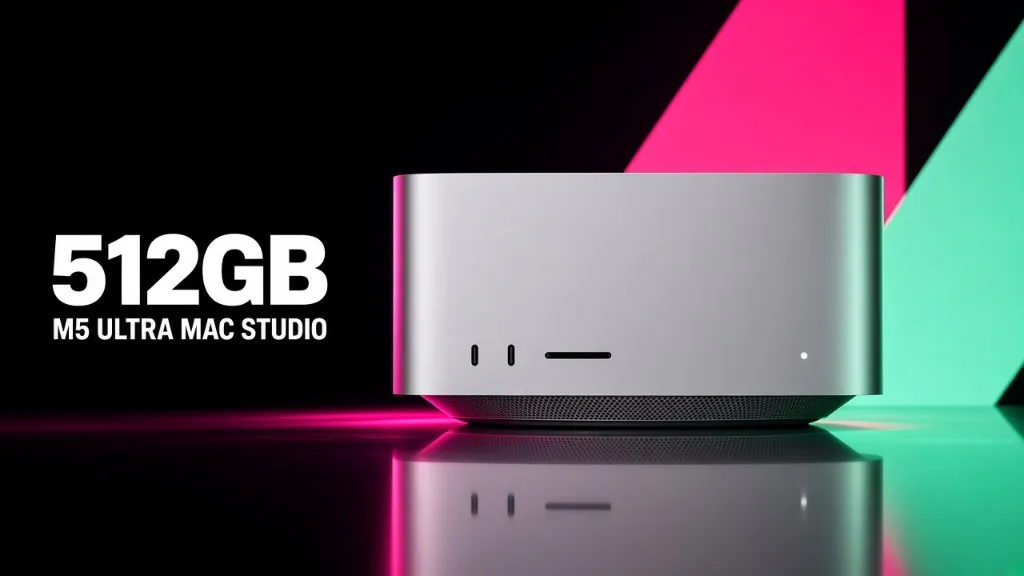
Is the Apple Mac Studio 512GB the New Local AI Goat?
Apple's 512GB M5 Ultra fits models that otherwise take four Nvidia DGX Sparks, and it generates text faster than any of the small AI boxes. It is slower at reading long prompts, the software is a patchwork, and the RAM upgrade alone costs as much as a car.
Updated Oct 29, 2026
Comparison
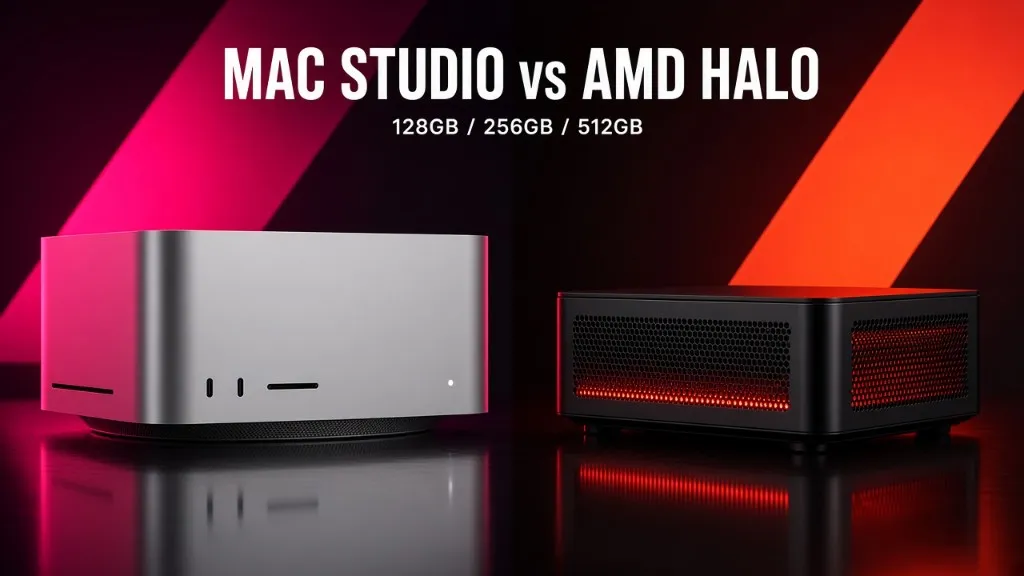
Should you Buy the Mac Studio or AMD Halo for Local AI in 2026?
The Mac Studio M5 Ultra is the faster machine, with up to 512GB at 1.2TB/s. AMD's Ryzen AI Halo lists at $7,299 with 192GB and about 273GB/s, and it is much slower at reading long prompts.
Updated Oct 29, 2026
Buying guide
The best Macs and mini PCs for running LLMs locally (2026)
Unified-memory machines hold models that no affordable graphics card can, but their slower memory means you have to choose your models with care.
Updated Oct 14, 2026