Comparison
Should you Buy the Mac Studio or AMD Halo for Local AI in 2026?
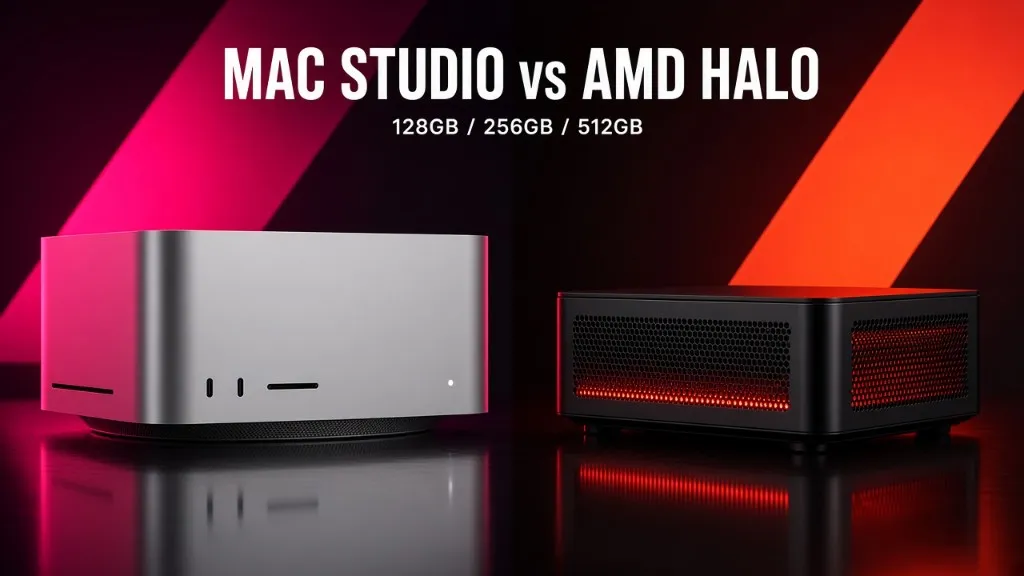
The Mac Studio M5 Ultra is the faster machine, with up to 512GB at 1.2TB/s. AMD's Ryzen AI Halo lists at $7,299 with 192GB and about 273GB/s, and it is much slower at reading long prompts.
Key takeaways
Buy the Mac Studio M5 Ultra when the model needs more than 192GB or token speed matters. Buy AMD's Ryzen AI Halo when $7,299 and 192GB are enough. The Halo has about 273GB/s against the Mac's 1.2TB/s, so long prompts are its weak spot.
In this article
AMD’s Strix Halo boxes are the cheapest way into big local models. The Mac Studio is cheaper once you need more than one
At 128GB, a Framework Desktop costs about $2,000 less than the matching Mac Studio. Once you need 256GB or 512GB, the Mac’s memory bandwidth and Thunderbolt 5 links matter more than the sticker price, and a Strix Halo cluster runs into its 10-gigabit network.
AMD’s Ryzen AI Max chips, known to most people as Strix Halo, did for local AI what the first Mac Studio did for video editing. They made a category affordable. A Framework Desktop with the Ryzen AI Max+ 395 and 128GB of memory costs $3,449 as a DIY kit. In October AMD added its own Ryzen AI Halo developer box with the Max+ PRO 495 and 192GB. It sells for $7,299, according to HotHardware.
If you’d like to try this GPU before you buy, consider renting on vast.ai.
Apple’s answer comes at three memory sizes. The M5 Max Mac Studio tops out at 128GB, and the M5 Ultra offers 256GB or 512GB. We priced all three against the AMD machines at equal capacity, including the cables and switches needed to join several boxes into one larger pool of memory. That last part decides the comparison more often than the chips do.
The price at each tier
Apple’s 128GB machine is the M5 Max with the 40-core GPU. It costs $5,399 with a 1TB SSD ($5,099 with 512GB, per AppleInsider’s price guide). The 256GB tier needs an M5 Ultra: $9,499 for the 30-core CPU and 64-core GPU, or $10,799 for the 36/80-core chip. The 512GB model comes only with the top chip and costs $22,299. Two 256GB Ultras cost $21,598 and give you the same 512GB.
On the AMD side, the Framework Desktop is the floor. HP’s Z2 Mini G1a uses the same chip and costs considerably more: Staples lists the 128GB, 1TB configuration at $5,543.92. Among 192GB machines, GMKtec’s EVO-X5 Pro undercuts AMD’s own box at $6,799.
| Tier | Mac Studio | Framework Desktop (Max+ 395) | Ryzen AI Halo (PRO 495, 192GB) |
|---|---|---|---|
| 128GB | M5 Max, $5,399 | 1 box, $3,449 (no SSD) | 1 box (192GB), $7,299 |
| 256GB | M5 Ultra 64c, $9,499 | 2 boxes, $6,898 + cable | 2 boxes (384GB), $14,598 + cable |
| ~512GB | 512GB Ultra $22,299, or 2x 256GB $21,598 + $69 cable | 4 boxes, $13,796 + $529 network | 3 boxes (576GB), $21,897 + $464 network |
| Bandwidth per box | 614GB/s (Max), 1.2TB/s (Ultra) | ~256GB/s | 273GB/s |
Hardware at list price plus the networking needed to join the boxes. Framework prices exclude storage.
The Framework is the cheapest option at every size. At 512GB, four of them cost about $7,500 less than two 256GB Macs. That gap is real, and for some buyers it ends the discussion. The rest of this piece explains why it shouldn’t for most.
Each Mac moves more data than several Halo boxes
Decode, the part of inference where the model writes its answer, is limited by how quickly the chip can read the model’s weights from memory. Strix Halo uses LPDDR5x on a 256-bit bus, which works out to about 256GB/s on the Framework and 273GB/s on AMD’s 495 box. The M5 Max reaches 614GB/s, and the M5 Ultra reaches 1.2TB/s.
Apple’s chips have 2.2x to 4.7x the memory bandwidth of Strix Halo.
Even the cheapest Mac in this comparison reads memory more than twice as fast as any Strix Halo machine. For a model that fits in both, the 128GB M5 Max should generate text roughly twice as fast as a 128GB Framework (est., from the bandwidth ratio). Clustering doesn’t close that gap either. Four Halo boxes running a model in pipeline-parallel mode take turns: each token passes through one box’s layers and then the next box’s, so the speed stays close to a single box’s bandwidth. More boxes buy capacity, not speed.
The gap is wider for prefill, the compute-heavy step of reading a prompt. AMD rates the PRO 495’s Radeon 8065S at up to 61 TFLOPS of FP16. The best Strix Halo result we found for GLM-5.3-Flash is from the Kyojin engine, which fits the model on one 128GB box at about 2–3 bits per weight. It reports 26.2–33.4 tok/s decode and 634 tok/s prefill at 8K tokens. MacStories measured an M5 Ultra at 1,107 tok/s prefill on the same model at a higher-quality quantization. For agent and coding work, where a long context gets reread on every turn, that difference is noticeable in every session.
What fits at each tier
Usable GPU memory is an estimate: macOS reserves about a quarter of RAM by default, and AMD exposes 160GB of the 495’s 192GB to the GPU.
At 128GB, both platforms are limited to mid-size MoE models such as Qwen3.8-Flash-Next at 4-bit, or aggressive 2–3-bit quantizations of GLM-5.3-Flash. macOS gives the GPU about 75 percent of memory by default, which you can raise with iogpu.wired_limit_mb. On Strix Halo, the split between CPU and GPU memory is set in firmware or the kernel.
At 256GB, a single M5 Ultra runs GLM-5.3-Flash at 4-bit (about 204GB) with room for context. The AMD route needs two machines. One 192GB Halo PRO 495 nearly fits it, but only 160GB is addressable as VRAM.
At 512GB, the question becomes DeepSeek V4.1-Flash, a 552B MoE with 16B active parameters during decode. Its 4-bit MLX build peaked at 294GB in one M3 Ultra test, which reported 53–63 tok/s. Strix Halo users currently run it at 2 bits with part of the model streamed from SSD using Niko1221/Strata, at 11–21 tok/s and 87–177 tok/s prefill. Spreading it across four Framework boxes would avoid the SSD streaming, but we found no published four-box Strix Halo benchmark for V4.1-Flash. Full GLM-5.3 at 4-bit (about 419GB) fits only the 512GB Mac with the memory limit raised, or a three-box 495 cluster.
If you’d like to try this GPU before you buy, consider renting on vast.ai.
The network decides the clustering math
Comparing a single machine against several gets misleading here, because Halo boxes have to be joined over some kind of network, and their networking is limited.
AMD’s Halo developer box has one 10GbE port and three USB-C ports. The Framework Desktop has 5GbE and USB4. AMD’s own RCCL clustering playbook calls for a 10GbE switch and Cat 7 cables, even for two units. LTT Labs clustered two Halos over 1GbE, 10GbE, and USB4. The USB4 link came up at 20Gb/s rather than the 40Gb/s it’s rated for, and the team saw only 200–500Mb/s of actual traffic during inference. It titled the piece “Underwhelming.” There’s no RDMA path comparable to Apple’s or Nvidia’s, so every hop goes through the regular TCP network stack.
Apple’s solution is to skip the switch. Since macOS 26.2, MLX and exo can use RDMA over Thunderbolt 5, which Apple rates at up to 120Gb/s in its asymmetric boost mode and 80Gb/s both ways. The M5 Ultra has six Thunderbolt 5 ports and the M5 Max has four, per MacRumors. Thunderbolt 5 switches don’t exist, so MLX’s RDMA backend requires a full mesh, with one cable between every pair of machines. Two Macs need one cable, three need three, and four need six. exo’s documentation notes that the port next to Ethernet can’t do RDMA, which leaves an M5 Max with exactly enough ports for a four-node mesh.
Rated line rate per link, except where marked as measured. RDMA support and latency differ between these links and matter as much as raw speed.
The parts are inexpensive either way. Apple’s 1m Thunderbolt 5 Pro cable costs $69. On the AMD side, the obvious budget choice is an SFP+ switch: MikroTik’s CRS309-1G-8S+IN has eight SFP+ ports at a $269 suggested price. The Halo boxes have RJ45 jacks, though, so each one needs a S+RJ10 10GBASE-T module at about $65. Four AMD nodes come to $529 before patch cables. Two can usually connect with a single direct Ethernet or USB4 cable, even though AMD’s playbook shows a switch.
Cables and switches only, at list price.
At the four-node size, the networking costs about the same: $414 in Thunderbolt cables against $529 in switch and modules. The bandwidth is very different. Each Thunderbolt 5 link carries eight times what a 10GbE port does, with RDMA, and every Mac has a direct path to every other Mac. A Halo cluster shares one 10GbE uplink per box through a switch. Going faster would require 25GbE or 100GbE, and MikroTik’s CRS504-4XQ-IN 100GbE switch is a reasonable $799. But Strix Halo mini PCs have no spare PCIe slot for a 100GbE NIC. The Framework Desktop’s single x4 slot could hold one at reduced bandwidth (est.). We couldn’t find anyone who has built that configuration.
Why link speed matters for one kind of parallelism
There are two ways to split a model across machines. Pipeline parallelism gives each box a contiguous group of layers and sends a small activation tensor to the next box for every token. That uses little bandwidth, which is why LTT barely saw any network traffic, and why llama.cpp’s RPC mode works acceptably over 10GbE. It also leaves every box but one idle while it waits for its turn.
Tensor parallelism splits each layer across all the boxes, so they work at the same time, but they have to synchronize after every layer. That multiplies the network traffic and makes latency the limiting factor. Apple’s distributed-inference tests on four M5 Ultras using tensor parallelism over Thunderbolt RDMA raised Qwen 3.8 27B from 19.7 to 50.9 tok/s, a 2.6x speedup from four machines. Over 10GbE without RDMA, a Strix Halo cluster is effectively restricted to pipeline parallelism. Adding boxes gives it more room for larger models but doesn’t make them run faster.
Software, power, and noise
Strix Halo runs Linux or Windows. It has ROCm and Vulkan backends for llama.cpp, the Kyojin engine for single-box GLM-5.3-Flash, and AMD’s RPC and RCCL playbooks for two-node setups. Kyojin doesn’t support distributed inference. Macs run MLX, the community servers built on it (oMLX, mlx-serve), llama.cpp’s Metal backend, LM Studio, and exo for clustering. Neither ecosystem has vLLM or SGLang at the maturity they have on CUDA.
AMD rates the PRO 495 at 120W TDP in a 150mm-square chassis. GMKtec’s version of the same chip ships with a 330W power supply and allows 160W peaks. Apple says an M5 Ultra drew around 300W during its cluster tests, and the Mac Studio is quiet under load in most reviews. We didn’t find matched noise measurements for the two platforms, so we’re not making a claim either way.
Which to buy
128GB: Framework Desktop, if you can live with slow prompts. At $3,449 it costs about two-thirds as much as the 128GB M5 Max. The Mac’s 614GB/s of bandwidth makes it the better machine for coding agents and long contexts. The AMD box is the better value for experimenting, running batch jobs, or running Linux.
256GB: one M5 Ultra. Two Framework boxes cost $2,600 less, but they’re two machines with a 5GbE or 20Gb/s USB4 link between them and a quarter of the bandwidth for each token. A single $9,499 Ultra runs GLM-5.3-Flash at 4-bit with no networking.
512GB: two 256GB Mac Studios on one $69 cable. That setup costs $21,667, less than the single 512GB Mac and about $7,700 more than four Framework boxes. For that extra money you get 2.4TB/s of combined bandwidth, RDMA tensor parallelism, and no switch. The four-Framework cluster is the budget choice for holding DeepSeek V4.1-Flash or GLM-5.3 at all. If you need either model to run quickly, the Macs are the stronger buy.
Buying advice
Our GPU picks for local AI
Best overall
RTX 3090Best budget
RTX 5060 Ti 16GBFastest consumer GPU
RTX 5090Best for multi-GPU builds
R9700
We may earn a commission when you buy through links on this page. It never changes what we recommend. How we make money
Frequently asked questions
How much does a Mac Studio cost compared with a Ryzen AI Halo?
In late October 2026, a Mac Studio M5 Ultra listed from $5,499 with 96GB to $9,499 or $10,799 with 256GB, and $22,299 for 512GB with the 36-core CPU, 80-core GPU, and 1TB of storage. AMD's Ryzen AI Halo developer box, with a Ryzen AI Max+ PRO 495 and 192GB, sold for $7,299 at Micro Center. A Framework Desktop with the same chip and 192GB started at $6,799.
How much memory can each one give the GPU?
macOS gives the GPU about 75 percent of unified memory by default, roughly 384GB on the 512GB Mac Studio, and the iogpu.wired_limit_mb setting can raise that. The Ryzen AI Halo has 192GB of LPDDR5X-8533, and AMD says up to 160GB can be addressed as VRAM.
Which is faster for local models?
The Mac Studio. Every M5 Ultra has 1.2TB/s of memory bandwidth, about 4.4 times the Halo's 273GB/s, so it generates tokens faster on models both can hold. The Halo's weaker GPU shows up when the machine has to read a long prompt.
Read next
More from Llama Builds
News
Is the Apple Mac Studio 512GB the New Local AI Goat?
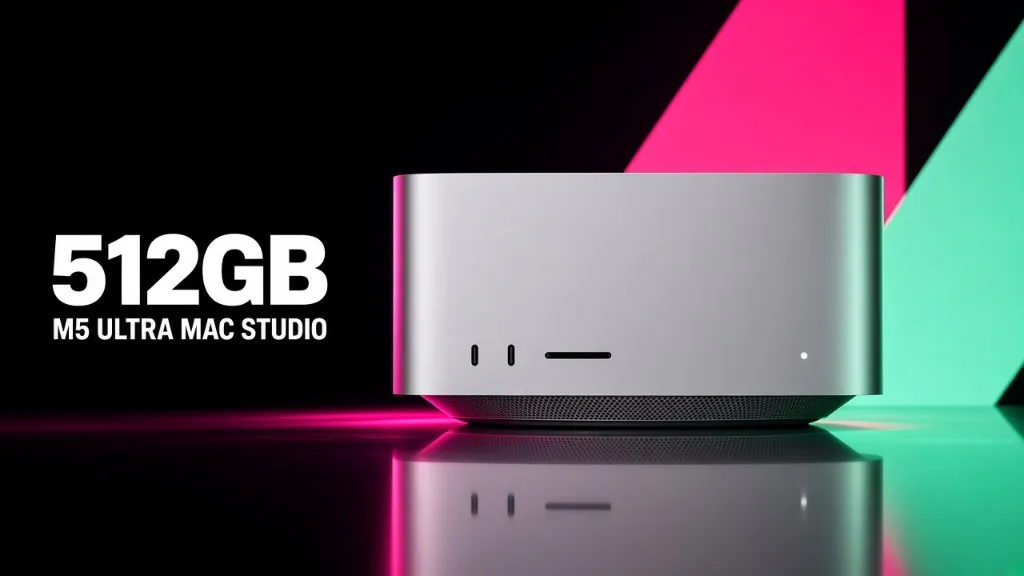
Apple's 512GB M5 Ultra fits models that otherwise take four Nvidia DGX Sparks, and it generates text faster than any of the small AI boxes. It is slower at reading long prompts, the software is a patchwork, and the RAM upgrade alone costs as much as a car.
Updated Oct 29, 2026
Buying guide
The best Macs and mini PCs for running LLMs locally (2026)
Unified-memory machines hold models that no affordable graphics card can, but their slower memory means you have to choose your models with care.
Updated Oct 14, 2026
Explainer
How much VRAM do you need to run LLMs locally?
Weights, KV cache and overhead, worked out with real numbers for the open models people actually run in 2026.
Updated Oct 14, 2026