News
Is the Apple Mac Studio 512GB the New Local AI Goat?
Apple's 512GB M5 Ultra fits models that otherwise take four Nvidia DGX Sparks, and it generates text faster than any of the small AI boxes. It is slower at reading long prompts, the software is a patchwork, and the RAM upgrade alone costs as much as a car.
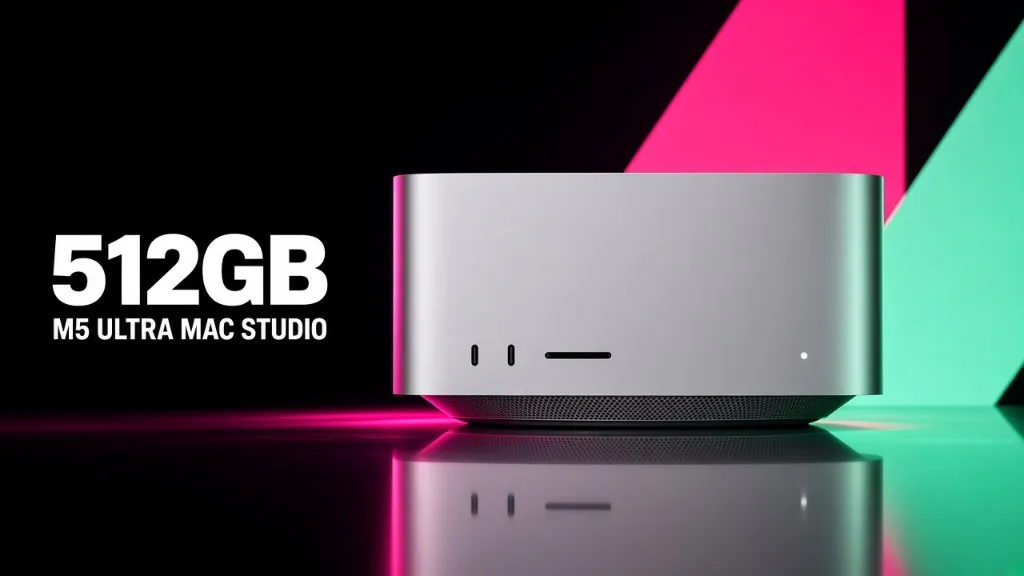
Apple started taking orders for the 512GB version of the M5 Ultra Mac Studio on October 28th, about two months after the chip launched. It costs $22,299 with the 36-core CPU, 80-core GPU, and 1TB of storage. Most of that is the RAM: AppleInsider counted $15,500 over the 96GB model. Orders placed now ship in late November or early December.
The customer for this configuration is obvious. It’s for people who want to run open-weight models in the 300 billion to 750 billion parameter range on one desk, with no cloud bill. The real question is whether it beats what that same person could build with Nvidia’s DGX Spark or AMD’s Strix Halo machines. For the most part it does. The exceptions matter, though.
If you’d like to try this GPU before you buy, consider renting on vast.ai.
What $22,299 buys
Every M5 Ultra has the same 1.2TB/s of memory bandwidth, 50 percent more than the M3 Ultra’s 819GB/s, according to Apple’s spec sheet. The price differences come from GPU core count and memory. You can only get 512GB with the higher 36-core CPU/80-core GPU bin.
| Configuration (1TB SSD) | Memory | Price | $ per GB | Bandwidth |
|---|---|---|---|---|
| M5 Ultra 30c CPU / 64c GPU | 96GB | $5,499 | $57 | 1.2TB/s |
| M5 Ultra 30c / 64c | 256GB | $9,499 | $37 | 1.2TB/s |
| M5 Ultra 36c / 80c | 96GB | $6,799 | $71 | 1.2TB/s |
| M5 Ultra 36c / 80c | 256GB | $10,799 | $42 | 1.2TB/s |
| M5 Ultra 36c / 80c | 512GB | $22,299 | $44 | 1.2TB/s |
| 2x M5 Ultra 36c / 80c, 256GB each | 512GB | $21,598 | $42 | 1.2TB/s each |
Prices from Macworld, 9to5Mac, and Tom’s Hardware (which reports the 96GB-to-256GB step as $4,000).
Going from 96GB to 256GB costs $25 per added gigabyte. Going from 256GB to 512GB costs $11,500, which works out to about $45 per gigabyte. As Macworld noted, two 256GB Studios cost about $700 less than one 512GB unit. They also give you twice the total bandwidth and twice the GPU cores, if your software can split the work across them. Days before Apple announced pricing, exo Labs CEO Alex Cheema predicted the 512GB machine would cost $15,899. The industry-wide memory shortage has pushed prices for nearly every product in this story well above launch levels.
Capacity decides what you can run. Bandwidth decides how fast
Running a language model has two phases. Prefill reads your prompt and is limited by compute. Decode generates the answer one token at a time and is limited by memory bandwidth. Federico Viticci explained it in the MacStories review: “the model writes one token at a time and pulls the entire model back out of memory for each one.”
That makes the math easy to sanity-check. Apple’s own distributed-inference paper ran Mistral Medium 3.5, a dense 128B model in FP8, on a single M5 Ultra at 7.7 tokens per second. Dividing 1.2TB/s by about 128GB of weights gives a ceiling near 9.4 tok/s, so the measured result is about 80 percent of the theoretical maximum. Mixture-of-experts models only read their active parameters for each token, which is why 300B- to 750B-parameter MoE models can run at usable speeds on this hardware.
Two caveats apply. First, macOS reserves only about 75 percent of unified memory for the GPU by default (llamaperf saw 192GB available on a 256GB machine). On the 512GB model that means roughly 384GB is available unless you raise the iogpu.wired_limit_mb setting. Second, Apple doesn’t publish a TFLOPS figure for the M5 Ultra. It claims “up to 4.3x” the M3 Ultra’s peak AI compute and up to 4x faster prompt processing in LM Studio.
Against graphics cards: faster, smaller, and expensive
On the models it can hold, an RTX 5090 is faster. MacStories ran Qwen 3.8 27B with a 6,091-token prompt. The 5090 read the prompt at 3,031 tok/s and generated at 59 tok/s. The M5 Ultra managed 1,701 and 48. The 5090 has only 32GB, though. When a larger model spilled out of VRAM into system RAM, its output dropped to 4.6 tok/s at 64K context and 1.5 tok/s at 256K. In one of Viticci’s tests the PC peaked at 567–577 watts, while the Mac stayed quiet.
Memory prices have also hit graphics cards. The 5090 launched at $1,999, but PC Guide tracked Amazon listings around $8,500 on October 22nd. Nvidia’s 96GB RTX PRO 6000 now lists for $16,000, almost double its 2025 launch price. Budget cards look cheap per gigabyte (an RTX 5060 Ti 16GB at its $429 MSRP is about $27/GB), but you’d need dozens of them to hold the models discussed here. Used 32GB Tesla V100s sell for around $900, and newer CUDA and vLLM releases are dropping support for that Volta architecture.
The GPU route’s lasting advantage is CUDA. vLLM, SGLang, TensorRT-LLM, and EXL3 quantization all target Nvidia first. One X user posted a full 755B GLM-5.3 running on four RTX PRO 6000s at 23–28 tok/s with 2,000–2,400 tok/s prefill. The cards alone would cost $64,000 at today’s list price.
If you’d like to try this GPU before you buy, consider renting on vast.ai.
Against the DGX Spark: the main comparison
Nvidia’s DGX Spark pairs a GB10 chip with 128GB of LPDDR5x at 273GB/s, plus a ConnectX-7 NIC with two QSFP ports rated up to 200Gb/s. Its price has climbed with memory costs. It launched at $3,999, rose to $4,699 in February, and now lists at $6,950. Nvidia also added a 64GB version from $4,999.
With roughly 4.4 times the bandwidth, the Mac should win decode, and it does. Tom’s Hardware found the M5 Ultra generated text almost four times faster than a Spark on Qwen 3.8 27B. The reported figures, as summarized by Contra Collective, are 46.3 versus 11.8 tok/s. Tom’s also measured faster prefill on the Mac.
Two Sparks connected over 200GbE close much of that gap. On October 18th, X user @satsuki2694 compared one 256GB M5 Ultra running oMLX against two GB10 boxes running vLLM with tensor parallelism. Both used multi-token prediction on a short coding prompt. The Mac led on Qwen3.8-Flash-Next (164.8 vs 116.0 tok/s) and GLM-5.3-Flash (73.1 vs 28.4), and was roughly even on DeepSeek V4 Flash (74.4 vs 68.0). The comparison used different runtimes and quantizations and didn’t check output quality. Viral charts showing the opposite result had the same problem, as @michaelbeal1 put it: “two charts arguing past each other.”
Prefill is where Nvidia’s compute shows. PixelML’s club-dgx-spark benchmarks record 2,960 tok/s for two Sparks on Qwen3.8-Flash-Next at 16K tokens. MacStories measured 2,887 on the M5 Ultra. On GLM-5.3-Flash, the two Sparks reached 1,277–1,372 tok/s against the Mac’s 1,107. Sparks also handle concurrent requests better. The same PixelML setup served 275 tok/s in aggregate across 16 simultaneous requests. MacStories saw the Mac go from 66 tok/s with one request to 81.5 tok/s with three.
That matters for agent workloads, where long contexts get reprocessed constantly. James McPherson, who owns both an M5 Ultra and four GB10 boxes, wrote there is “not a massive difference in performance in real world workloads.” Cheema argues the opposite: most agent workloads are decode-heavy, but “if your workload happens to be prefill heavy, it’s not great.”
Matching the Mac’s 512GB takes four Sparks: $27,800 at current list price, plus a 200GbE switch, which Nvidia’s clustering guide requires for four nodes. The scaling is real. Nvidia’s own tests cut Llama 3.3 70B time-per-token from 269ms on one node to 72ms on four, and one user has run full GLM-5.3 across four Sparks at 2.75 bits per weight. On power, each Spark ships with a 240W supply. Apple says an M5 Ultra peaked around 300W during its cluster tests. One off-grid user reported that two Sparks drained his battery bank in a day, while an M3 Ultra did not.
Against AMD’s Strix Halo: cheaper per gigabyte, much slower to prefill
AMD’s Ryzen AI Max+ 395 is the low-cost option. The Framework Desktop with 128GB costs $3,449 as a DIY kit without storage. That’s about $27/GB, with roughly 256GB/s of bandwidth from LPDDR5x-8000 on a 256-bit bus. HP’s Z2 Mini G1a uses the same chip family. On October 12th AMD added a Ryzen AI Halo developer box with the Max+ PRO 495, 192GB of LPDDR5X-8533, and up to 160GB addressable as VRAM. It sells for $7,299 through Micro Center, according to HotHardware.
Bandwidth puts Strix Halo in the same class as the Spark for decode. The weaker GPU shows up in prefill. The Kyojin engine fits GLM-5.3-Flash on one 128GB box at roughly 2–3 bits per weight (99.7GB) and reports 26.2–33.4 tok/s decode and 634 tok/s prefill at 8K. AIFinitee measured 89 percent top-1 token agreement with the FP8 weights at that quantization. DeepSeek V4.1-Flash at 2 bits, streamed partly from SSD with Strata, runs at 11–21 tok/s, with prefill between 87 and 177 tok/s. At that rate a 32K-token codebase takes minutes to read. Clustering is also weak: these machines have no equivalent to ConnectX-7 or Thunderbolt RDMA, and Kyojin doesn’t support distributed inference.
| Mac Studio M5 Ultra | DGX Spark | Ryzen AI Max+ 395 (Framework) | Ryzen AI Halo (PRO 495) | |
|---|---|---|---|---|
| Max memory per box | 512GB | 128GB | 128GB | 192GB (160GB to GPU) |
| Bandwidth | 1.2TB/s | 273GB/s | ~256GB/s | ~273GB/s |
| Price at max memory | $22,299 | $6,950 | $3,449 (no SSD) | $7,299 |
| Cost to ~512GB | $22,299 (1 box) or $21,598 (2) | $27,800 + switch | $13,796 (4 boxes) | $21,897 (3 boxes, 576GB) |
| Interconnect | Thunderbolt 5 RDMA | ConnectX-7, 2x 200GbE | USB4 / 5GbE | Not specified for clustering |
| Main software | MLX, llama.cpp, LM Studio, exo | CUDA, vLLM, SGLang, TensorRT-LLM | llama.cpp, ROCm/Vulkan, Kyojin | Same as 395 |
| Qwen 3.8 27B decode (Tom’s) | 46.3 tok/s | 11.8 tok/s | not tested | not tested |
What 512GB actually runs
The newest open models fill the space between “fits on a Spark” and “needs a data center.”
DeepSeek V4.1-Flash is the obvious first choice. Its model card lists a 552B MoE backbone with 8B active parameters for prefill and 16B for decode, plus a 196B “Engram” memory table. It’s MIT-licensed, supports 1M tokens of context, and uses only about 890 bytes of KV cache per token, so a full million-token context needs under a gigabyte. On an M3 Ultra with 512GB, @AIRoboticsInt reported a 4-bit MLX build peaking at 294GB, generating 53–63 tok/s from 4K to 195K context with 722–902 tok/s prefill. @tianxi_tx measured up to 80.7 tok/s at 3 bits on the same hardware. The mlx-serve card shared by @MLXapp shows 69.4 tok/s on a 256GB M5 Ultra, but only by reading 203GB of Engram tables from SSD. On a 512GB machine they fit entirely in memory. FP8 needs two 512GB Macs.
GLM-5.3, Z.ai’s 753B flagship (about 40B active, per Nvidia’s NIM reference), is around 419GB at 4-bit. That fits only if you raise the GPU memory limit. On an M3 Ultra, one user measured 14.58 tok/s generation and 146 tok/s prefill with Unsloth’s Q4_K_XL. Scaling that by the bandwidth increase suggests roughly 21 tok/s on an M5 Ultra (est.). That’s fine for overnight jobs and slow for interactive coding. GLM-5.3-Flash (320B, 18B active) is the more practical choice: about 204GB at 4-bit and 320GB at 6-bit. Only the 512GB Mac fits the higher-quality 6-bit version.
Qwen3.8-Flash-Next (roughly 180B total including its n-gram tables, 6B active) fits at 8-bit in about 240GB. At 4-bit, MacStories measured 108 tok/s on the M5 Ultra. Qwen’s 2.4-trillion-parameter flagship, DeepSeek V4-Pro (1.6T), and Meta’s 816B Muse Spark Open (493GB at NVFP4, per Apple) don’t fit on one machine. They need a cluster.
The software: MLX, llama.cpp, exo, and two projects called Strata
Apple’s MLX and community servers built on it, such as oMLX and mlx-serve, produce most of the fastest Mac results. llama.cpp is the portable baseline: llamaperf measured 4,911 tok/s prefill and 119 tok/s decode on a small 8-bit model, about 1.64 times the M5 Max rather than double it. LM Studio wraps both. Cheema, whose company benefits from the Mac selling well, still says “the software on Apple Silicon is not great,” with “about 30 competing inference engines.”
Clustering is where the Mac software has improved most. exo and MLX use RDMA over Thunderbolt 5 on macOS 26.2 and later. In Apple’s tests, four M5 Ultras running tensor parallelism raised Qwen 3.8 27B from 19.7 to 50.9 tok/s and served the 816B Muse Spark Open at 36.7 tok/s. exo’s widely shared 2025 demo, which split prefill onto two Sparks and decode onto a Mac, is harder to reproduce: exo’s README says Linux support is CPU-only, and one tester found the Spark worked only as a memory donor.
“Strata” refers to two unrelated projects. ro99/strata is a CUDA-only engine that spreads models across VRAM, RAM, and NVMe, and it has no Metal backend. Niko1221/Strata does support Apple Silicon, along with Nvidia, AMD, Intel, and DGX Spark. Its published Mac numbers come from an M5 Max (98 tok/s on Qwen3.8-Flash-Next with MTP), not an Ultra. Its project site, stratat.com, didn’t load during reporting.
Should you buy one?
If you want one quiet box that holds DeepSeek V4.1-Flash entirely in memory, GLM-5.3-Flash at 6-bit, or full GLM-5.3 at 4-bit, the 512GB M5 Ultra is the most straightforward way to do it. In every head-to-head decode test we found, it beat both a single Spark and a pair of Sparks, and field reports put it well ahead of Strix Halo.
It’s a weaker choice if your work is mostly long-prompt prefill, serving many users at once, or depends on CUDA tooling. Two Sparks already match it on prefill, and multi-Spark clusters scale under concurrent load in ways a single Mac doesn’t. Strix Halo is the cheapest way to experiment, as long as slow prompt processing is acceptable.
Within Apple’s lineup, two 256GB Studios cost less than one 512GB Studio and come with twice the compute, provided you’re comfortable with exo or MLX’s distributed mode. And at $22,299, as @gherget pointed out, the comparison with paying OpenRouter per token isn’t flattering. Buy this machine for privacy, control, and fixed costs. It won’t save you money.
Frequently asked questions
How much does the 512GB Mac Studio cost?
Apple started taking orders on October 28, 2026. The 512GB configuration with the 36-core CPU, 80-core GPU, and 1TB of storage costs $22,299. Orders placed then ship in late November or early December. AppleInsider counted the memory upgrade at $15,500 over the 96GB model.
How much of 512GB can the GPU use?
About 384GB by default, roughly 75 percent of unified memory. The iogpu.wired_limit_mb setting can raise that, as long as macOS keeps enough memory for itself.
Is the 512GB Mac Studio faster than a DGX Spark?
On text generation, yes, in the tests cited here. Tom's Hardware measured 46.3 tok/s on the M5 Ultra against 11.8 tok/s on a DGX Spark for Qwen 3.8 27B. Long-prompt processing and serving many users at once are closer, and a pair of Sparks can match the Mac on prefill. Four Sparks list at $27,800 plus a switch to reach about 512GB.
Read next
More from Llama Builds
Buying guide
The best Macs and mini PCs for running LLMs locally (2026)
Unified-memory machines hold models that no affordable graphics card can, but their slower memory means you have to choose your models with care.
Updated Oct 14, 2026
Explainer
How much VRAM do you need to run LLMs locally?
Weights, KV cache and overhead, worked out with real numbers for the open models people actually run in 2026.
Updated Oct 14, 2026
Buying guide
The best GPUs for running AI models locally (2026)
Memory decides which models you can run, and memory bandwidth decides how fast they answer. These are the cards that give you the most of both for the money.
Updated Oct 14, 2026