Opinion
Is the Tesla T10 16GB the new best budget ai GPU?
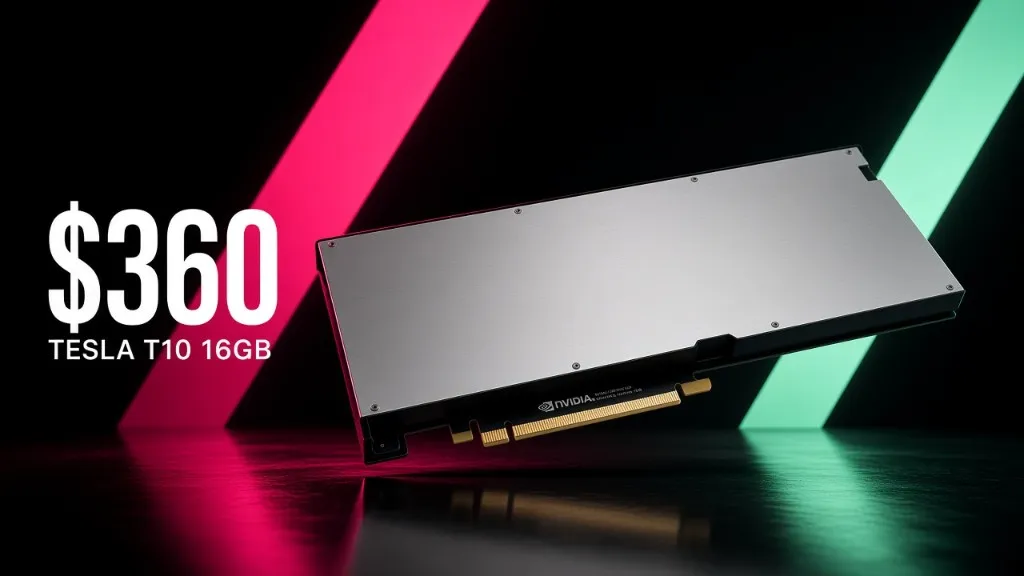
16GB of GDDR6 at 403 GB/s, in a 150W single-slot board with no monitor output. It covers the same 9B to 20B models as any other 16GB card, and it ships without a fan.
Key takeaways
The Tesla T10 is a 2020 Turing card with 16GB of GDDR6 at 403.2 GB/s and a 150W single-slot board. On this site, 16GB covers 9B to 20B models at Q4_K_M. Qwen3.8 27B at that quant is about 18GB at 8K context, so it does not fit. The board is passively cooled and has no display outputs.
In this article
The Tesla T10 is a $360 Turing card with 16GB of VRAM. Buy it for small models, not for DeepSeek
NVIDIA built the T10 for cloud gaming servers and never sold it at retail. Now it’s showing up on eBay in volume. It’s a real deal for 9B to 27B models, as long as you can cool it and don’t expect it to carry a frontier model.
On the morning of October 30, a Japanese homelab builder who posts as @Unagi_Dojyou shared photos of two bare silver cards with no fans, no display outputs and an NVIDIA logo on the edge. “Got two Nvidia Tesla T10 16GBs!!!” the post reads. “32,000 yen each.” The post picked up more than 16,000 views and 260 likes within hours. He bought them on Xianyu, China’s secondhand marketplace, through a Chinese acquaintance.
The T10 is still a niche card even among people who run local models. One European commenter in a r/LocalLLaMA thread admitted “I didn’t know about T10 until now.” That’s starting to change. Here’s what the card actually is, what it costs, and how far 16GB of Turing memory gets you in late 2026.
We may earn a commission when you buy through links on this page. It never changes what we recommend. How we make money
To try NVIDIA GPUs before you buy, rent one on vast.ai.
Current Tesla T10 16GB listings on eBay are in this search:
One listing from that market:
What NVIDIA built
The T10 is a datacenter part that launched in February 2020 for NVIDIA’s GeForce NOW cloud gaming servers. NVIDIA never published a public datasheet. The specs below come from TechPowerUp’s database and from GPU-Z readings of real cards. Its PCI device ID is 1E37, and the board number is PG150, sold under part number 699-2G150-0215-505.
One correction to the way the card is usually described: the T10 is not a TU104 card like the Tesla T4. It uses a cut-down TU102, the same die as the RTX 2080 Ti and Titan RTX, with 3,584 of the chip’s 4,608 shaders enabled.
| Tesla T10 | |
|---|---|
| GPU | TU102 (Turing, 12nm), 3,584 CUDA cores, 448 Tensor cores |
| Memory | 16GB GDDR6, 256-bit, 12.6 Gbps |
| Bandwidth | 403.2 GB/s |
| FP32 / FP16 (shader) | ~10 TFLOPS / ~20 TFLOPS |
| Tensor throughput | ~80 TFLOPS FP16, ~160 TOPS INT8 (VRAMGlass) |
| Power | 150W, one 8-pin connector |
| Form factor | Full-height, single-slot, 267mm long, passive heatsink |
| Interface | PCIe 3.0 x16, no display outputs, no NVLink |
| CUDA compute capability | 7.5 (sm_75) |
That makes the T10 easy to describe. A Reddit user who ranks it above the AMD MI50 calls it “a 16GB RTX 2080 with 150W TDP,” and elsewhere “basically a single-slot RTX 2080 with more VRAM.” For context, the more common Tesla T4 is a 70W, low-profile TU104 card with 320 GB/s. The T10 has more bandwidth and more compute, and it needs twice the power and a full-height slot.
One detail of the user’s framing needs a fix: the T10 is single-slot and passive, but it is not low-profile. It’s a full-height, 10.5-inch card. That’s what made it a fit for dense GeForce NOW servers, where a row of single-slot cards sits in front of loud server fans. In the thread, @Unagi_Dojyou’s main praise was that it “doesn’t block the neighboring slot.”
Why they’re on eBay now
The T10 never had a retail box, so every card on eBay was once installed in a server. A US seller who listed 40 of them on r/homelabsales said they came out of an NVIDIA P3454 20-node “RTX Blade Server” built for cloud gaming. That works out to two cards per node. The seller also offered the complete chassis, and the cards shipped without PCIe brackets because the blades never needed them. That is why some listings come with 3D-printed brackets, or with none at all.
The timing tracks GeForce NOW’s hardware cycle. NVIDIA started rolling out Blackwell “RTX 5080-class” SuperPODs on September 10, 2025 and finished its own regions in November. Partner-run regions were told to expect the upgrade in 2026. NVIDIA hasn’t said what it did with its Turing hardware. The supply pattern suggests that these cards come from retired fleets, but no source we found confirms it.
Most of the supply comes through China. A Taiwanese reviewer found T10s on Xianyu in January 2025 for about ¥1,350 (roughly $190) and described them as retired GeForce NOW cards. @Unagi_Dojyou bought his pair on Xianyu too. Today, many eBay listings ship from Shenzhen. That’s the usual path for decommissioned datacenter hardware: recyclers strip the servers and sell the parts in bulk, and resellers list them abroad.
The low price has a few causes. The card has no display outputs and no fan, which keeps gamers away. It has no official datasheet, needs a modified driver on Windows, and comes with no warranty. Homelab buyers weren’t sold either. Under that same 2025 listing at $480, commenters called the cards “kinda overpriced for their age”. By July 2026, the seller had cut the price and still had 30 left.
What changed is local AI. 16GB of CUDA memory for under $400 is now a common topic on r/LocalLLaMA, and the sold median rose 37% in 30 days. Demand from LLM hobbyists is a plausible explanation, but it’s our inference. No tracker breaks down who is buying.
What it costs right now
The price is the point. In Japan, @Unagi_Dojyou paid ¥32,000 per card through Xianyu. In the US, prices are higher and moving.
- eBay sold median: $362.07, with a $346 to $370 range across four qualifying sales, according to PC Part Value (data collected October 26). The tracker says the median rose 37.1% in 30 days.
- eBay active listings: $350 to $585, with US sellers rated “top rated” clustering at $495, per VRAMGlass (updated October 30).
- Shenzhen sellers: $369 plus $5 shipping in one listing showing 37 sold.
- Catalyst Data Solutions: $960, refurbished, one in stock, with 8/5 support (listing). That’s the price of a reseller with a support contract. It isn’t the market price.
- Europe: the Reddit poster found two cards at €200 each. A commenter replied that the cheapest he could find was €250 from China, with everything else over €350.
We couldn’t load eBay’s own search results directly, since eBay blocked the request. The figures above come from trackers that read eBay sold and active listings.
At about $22.60 per gigabyte, the T10 undercuts the T4 and every consumer 16GB card. The V100 16GB is still slightly cheaper.
Price per gigabyte puts the card in context. At the sold median, the T10 costs about $22.60 per GB of VRAM. That beats a Tesla T4 at $442 ($27.60/GB), a used RTX 3060 12GB at $300 ($25/GB), and a used RTX 5060 Ti 16GB at $661 ($41.30/GB), per PC Part Value’s used medians. It doesn’t beat a PCIe V100 16GB at $329 ($20.60/GB), and it’s nowhere close to a 24GB P40 at $275. The P40 is a 2016 Pascal card with weak FP16, though, and that comparison flatters it.
The T10 is a very small GPU, a single slot where a V100 16GB takes two. If you can still find that dual-slot V100, it is the better buy. Its memory bandwidth is 900 GB/s, more than twice the T10’s 403 GB/s, and at $329 it is cheaper per gigabyte, about $20.60 against about $22.60.
Try NVIDIA GPUs before you buy a used card, and rent one by the hour on vast.ai.
Two more eBay listings. Asking prices on these move, and shipping still changes the landed cost, which is the same spread as the sold median and the active range above.
Bandwidth is the ceiling
When a model fits entirely in VRAM, generating each token means reading the active weights once. Decode speed tracks memory bandwidth, so this is where the T10’s budget origins show.
The T10’s 403 GB/s is about 10% below an RTX 5060 Ti and less than half of a V100.
At 403 GB/s, the T10 lands about 10% behind an RTX 5060 Ti 16GB and less than half of a V100’s HBM2. One Reddit user puts a single-card number on it: “15-20t/s for Qwen3.8-27B w/o MTP.” VRAMGlass’s bandwidth-based estimates are about 40 tok/s for Gemma 4 12B at 4-bit and about 121 tok/s for Qwen3.6 35B-A3B at 2-bit. Those are modeled numbers, not measurements, so treat them as ceilings.
The other half of the picture is prefill, which is compute-bound. Here the T10’s 448 tensor cores beat older cards. The same Reddit user says the T10 is “much better for prefill when comparing against MI50,” the AMD card the original poster was also considering. The MI50 has more than double the bandwidth at around 1TB/s, and the T10 is the better choice when prompts are long.
What fits on one, two and four cards
One T10 is a 9B to 12B card at 4-bit. Two cards open up the 27B to 35B class. Four still can’t hold a 100GB-plus MoE.
One card (16GB): This is a 9B to 12B model card at 4-bit, with room left for context. Per VRAMGlass’s footprint tables, Qwen3.8 27B at 4-bit is 16.5GB and doesn’t fit without dropping to a 2-bit or 3-bit quant.
Two cards (32GB): This is the sweet spot. Qwen3.8 27B, Gemma 4 31B and Qwen3.6 35B-A3B all fit at 4-bit with room for KV cache. The cards don’t have NVLink, so llama.cpp splits layers across them over PCIe. Tensor parallelism in vLLM works too, but traffic crosses PCIe 3.0, and its speedup on these cards is unverified.
Four cards (64GB): This needs a server or workstation with four x8-or-better slots and serious airflow, and 600W for the GPUs alone. It should hold 70B-class dense models at 4-bit (about 40GB, est.) and mid-size MoEs. It still isn’t enough for the 100GB-plus “Flash” class of MoE models without offloading to system RAM.
The DeepSeek experiment
That brings us back to Japan. @Unagi_Dojyou installed both cards in an Intel S2600GZ server, a decade-old dual-socket board with two Xeon E5-2697 v2 chips and DDR3 memory, running Proxmox. His nvidia-smi screenshot shows both cards detected on driver 615.71.10 with CUDA 13.4, at 39 to 41W idle and a 150W cap. That’s useful evidence that current NVIDIA drivers still support the card. Then he tried an 8-bit DeepSeek model, and posted the result with a dry verdict: “with two T10s and two E5-2697 v2s, Q8 DeepSeek is just not happening.”
His monitor screenshot shows why. Here’s what it reports, translated into a chart.
Recreated from @Unagi_Dojyou’s monitor screenshot. Almost the whole model lived in old DDR3, so the GPUs could barely help.
The numbers from the screenshot:
| Metric | Reported value |
|---|---|
| Decode speed | 0.3 tok/s (peak 0.4) |
| Prefill | 1 tok/s |
| Time per token | 3,162.5 ms |
| Sample request | 35-token prompt, 79 tokens out, 240.6 seconds |
| Expert placement | RAM: 15,576 expert entries (292.8GB). VRAM: 1. The panel reports 15,360 routed experts live |
| VRAM hit rate | 5.1% (3.6% on the logged request) |
| CPU work | 245.35 experts per token computed on the CPU from RAM |
| GPU use | 28.2 of 32GB. 14.6GB weights, 5.1GB prompt buffers, 3.5GB draft model, 1.9GB tensor-parallel buffers |
| GPU link | PCIe Gen3 x8 per card |
| Power and temperature | 124W across both cards, 57°C peak |
| System RAM | 279.7 of 332GB used |
The engine is a custom build labeled maya-ds4. We couldn’t identify it, and nothing in the screenshot ties it to Strata. The lesson is the same one from our surplus-workstation guide. When experts run on the CPU, platform memory bandwidth sets the speed, and Ivy Bridge DDR3 is about as slow as it gets. The poster also complained that “the PCIe bandwidth is disappointing”, since each card got only eight Gen3 lanes. The T10s weren’t the bottleneck. They were sitting idle while the CPUs did the work.
We found no published run of DeepSeek-V4.1-Flash through Strata on T10s, so we can’t give a number. Strata’s official DeepSeek packages target sm_86 and newer. As with the V100, a T10 (sm_75) would need a community source build.
Software support in late 2026
Turing is old but not abandoned. The nvidia-smi output above shows driver 615 and CUDA 13.4 running on the T10. Earlier, NVIDIA’s Linux 550 driver README already listed the card by name. llama.cpp works well on Turing, and the same Reddit regular notes that vLLM’s v1 backend supports Volta and Turing, “albeit much slower than the legacy v0 backend.”
The gaps are real, though. Turing has no BF16, so BF16 checkpoints run in FP16 or get converted. It also lacks FP8 and FP4 tensor support, so you’ll rely on GGUF, AWQ and GPTQ-style integer quants rather than the NVFP4 builds newer cards use. Windows is harder. According to VRAMGlass, the standard driver doesn’t recognize device 1E37, and owners have used AWS’s cloud gaming driver or a GRID driver patched with NVCleanstall. Plan on Linux.
Cooling, power and fit
The T10 has a heatsink and nothing else. In a server, a wall of fans pushes air through it. In a desktop case, VRAMGlass reports it hits 85°C almost immediately under load and throttles above 86°C. The common fix is to swap in an RTX 2080 Ti blower shroud with a fan wired to the motherboard, which turns it into a two-slot card. The other route is a 3D-printed duct with a 40mm or 60mm fan on the bracket end. The Reddit thread mentions “lots of 3D printed solutions,” but notes the single-slot design makes it harder than usual. High-RPM blowers are loud, so budget for noise as well as the shroud.
Each card needs an 8-pin connector. Check whether yours is a standard PCIe 8-pin or a CPU/EPS-style 8-pin, as on many Tesla cards, before plugging anything in. Ask the seller, or buy the right adapter. Two T10s need 300W at full load, so a 650W supply is enough for a modern single-socket system. A four-card build belongs in a server chassis.
(eBay blower / fan shroud adapter links — to be added)
Risks before you click Buy
- No warranty, unknown history. These are pulls from cloud gaming servers, and one bulk seller traced its stock to NVIDIA RTX blade servers. Assume years of 24/7 duty. Most eBay sellers offer 30-day returns at best.
- Misleading listings. Look for “T10 8G” titles. The PCI database registers the card’s GRID profiles as “T10-4” and “T10-8,” but there’s no 8GB T10. Also, search with “1E37” or “699-2G150” so you don’t end up with the unrelated 2008-era “Tesla T10 Processor.” Run
nvidia-smithe day the card arrives. - Missing brackets. Some pulls ship without a bracket, or with one that doesn’t fit your case.
- Consumer boards. There’s no video output, so you’ll need an iGPU or a second card. Older boards may need Above 4G Decoding enabled to map a 16GB card.
- Market timing. The sold median rose 37% in a month. Buying several cards now means paying for the rising demand. Supply depends on how many retired servers recyclers break down, and nobody publishes that number.
eBay listings
Here’s what the T10 listings looked like at the end of October. The asking prices are close together, but delivery fees change the cost a lot. Neither of the two sellers shipping from the US is the cheapest once shipping is added.
US seller ai-depot: $350 or best offer, about $372 delivered. It’s the cheapest landed price here, but the seller has only four reviews.
Top-rated US seller core4solutions: $495 with free shipping and free returns. This is the “top rated” price level that trackers report.
China seller csz168: $352 looks cheap until you add $94.99 for delivery and import fees, which brings it to about $447.
China seller ppsprinterpartsseller: $425.55 delivered with import fees included and free returns. Fifty-nine sold suggests a seller working through bulk stock.
The landed prices run from about $372 to $495. All of them sit above the $362 sold median, and that median comes from only four sales. Of the two buy-it-now listings from China, the one with free shipping is cheaper delivered than the $352 listing. Import fees are already included on both China listings, so there’s no surprise duty at the door. On the other hand, returns cross the Pacific, and these cards ship without any cooling. The US listings arrive faster and are easier to send back. The cheapest one, though, comes from a seller with almost no feedback, so check its photos and the “Tested” claim before you make an offer. Two of the listings accept best offers. Given that the asking prices are above what cards actually sell for, an offer near $350 is reasonable.
(eBay listing URLs — to be added)
Verdict
Buy the T10 if you have a Linux box with a spare x16 slot and space for a shroud, and you want 16GB of CUDA memory for 9B to 12B models, or 32GB across two cards for the 27B to 35B class, at around $360 per card. It’s also one of the few 16GB cards that fits a single slot, which matters for dense builds and small-form-factor boxes.
Skip it if you can still find a dual-slot V100 16GB. The T10 is very small, but the V100 is cheaper per gigabyte and has much more memory bandwidth, and our chassis guide covers how to house one. Also skip it if you want a plug-and-play Windows card (look at a 5060 Ti), or if you hope two of them will carry DeepSeek. The Japanese experiment shows that a big MoE is limited by the platform’s RAM, not the GPU.
At $362, the T10 is a good buy for small models, not a shortcut to frontier-size ones. The best purchase is the one @Unagi_Dojyou made: two cards at about ¥32,000 each. At $495 and up, the V100 is the better choice.
Buying advice
Our GPU picks for local AI
Best overall
RTX 3090Best budget
RTX 5060 Ti 16GBFastest consumer GPU
RTX 5090Best for multi-GPU builds
R9700
We may earn a commission when you buy through links on this page. It never changes what we recommend. How we make money
Frequently asked questions
How much memory does the Tesla T10 have?
16GB of GDDR6 on a 256-bit bus, for 403.2 GB/s. TechPowerUp lists it as a 2020 TU102 card, 150W, single-slot, with one 8-pin power connector, a PCIe 3.0 x16 link, and no display outputs.
Can a Tesla T10 run a 27B model?
Not Qwen3.8 27B at Q4_K_M. That model is about 18GB at 8K context, which is past 16GB. The same memory tier covers 9B to 20B models, including gpt-oss-20b at about 15GB.
Does a Tesla T10 need a fan?
Yes, in a desktop. The board is passively cooled for server airflow and has no display outputs, so it needs a fan on the card and it cannot drive a monitor.
Read next
More from Llama Builds
Opinion
Is the RTX 3090 still the best GPU for local AI in 2026?
Six years after launch, it's still the card I tell most people to start with. Here's why, and where it stops being the right answer.
Updated Oct 14, 2026
Buying guide
Why the RTX A4500 is a great buy for local AI
20GB of ECC memory at 640 GB/s, in a 200W dual-slot card. Enough for a 27B model at 4-bit, and easier to power than a used RTX 3090.
Updated Oct 27, 2026
Buying guide
The best GPUs for running AI models locally (2026)
Memory decides which models you can run, and memory bandwidth decides how fast they answer. These are the cards that give you the most of both for the money.
Updated Oct 14, 2026